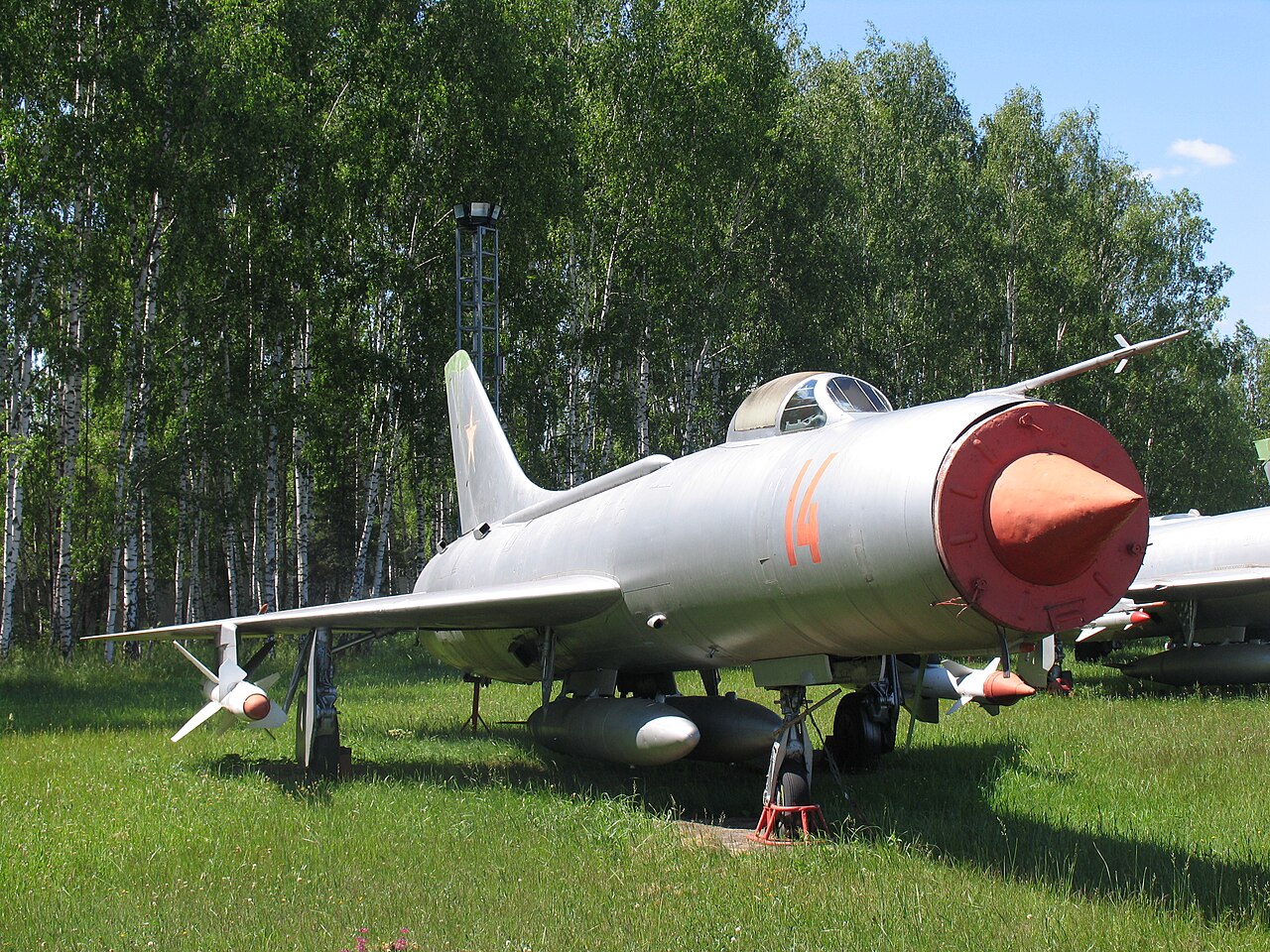
On December 25, 1958, the Soviet Union officially marked a milestone in aviation history with the first flight of the Sukhoi Su-11 Fishpot-C. This modern interceptor aircraft was an evolution of the earlier Su-9 Fishpot, designed to overcome limitations of its predecessor and enhance Soviet air defense capabilities during the Cold War era.
The Su-11 featured a longer fuselage to house the upgraded Oryol radar, along with a more powerful Lyulka AL-7F-1 turbojet engine, enabling it to reach speeds over Mach 2.2. Armed with two K-8 air-to-air missiles, the aircraft had a range of 310 nautical miles and a service ceiling of 59,000 feet. Its distinctive design included external fuel pipes atop the fuselage and a cigar-shaped body with a circular nose intake.
Legacy and Present Day
Produced between 1962 and 1965, a total of 108 Su-11 units were built. Today, only one example remains, serial number 0115307, which is displayed outdoors at the Central Air Force Museum in Monino, Russia. The aircraft's development reflected the Soviet Union’s focus on high-speed interception, and its design improvements contributed to the nation's strategic defense.
The Sukhoi Su-11 remains a significant part of Soviet aviation history, exemplifying technological progress during the Cold War. Its legacy endures as a symbol of the era’s aviation innovation, and the surviving aircraft provides valuable insight into Soviet aerospace advancements.

