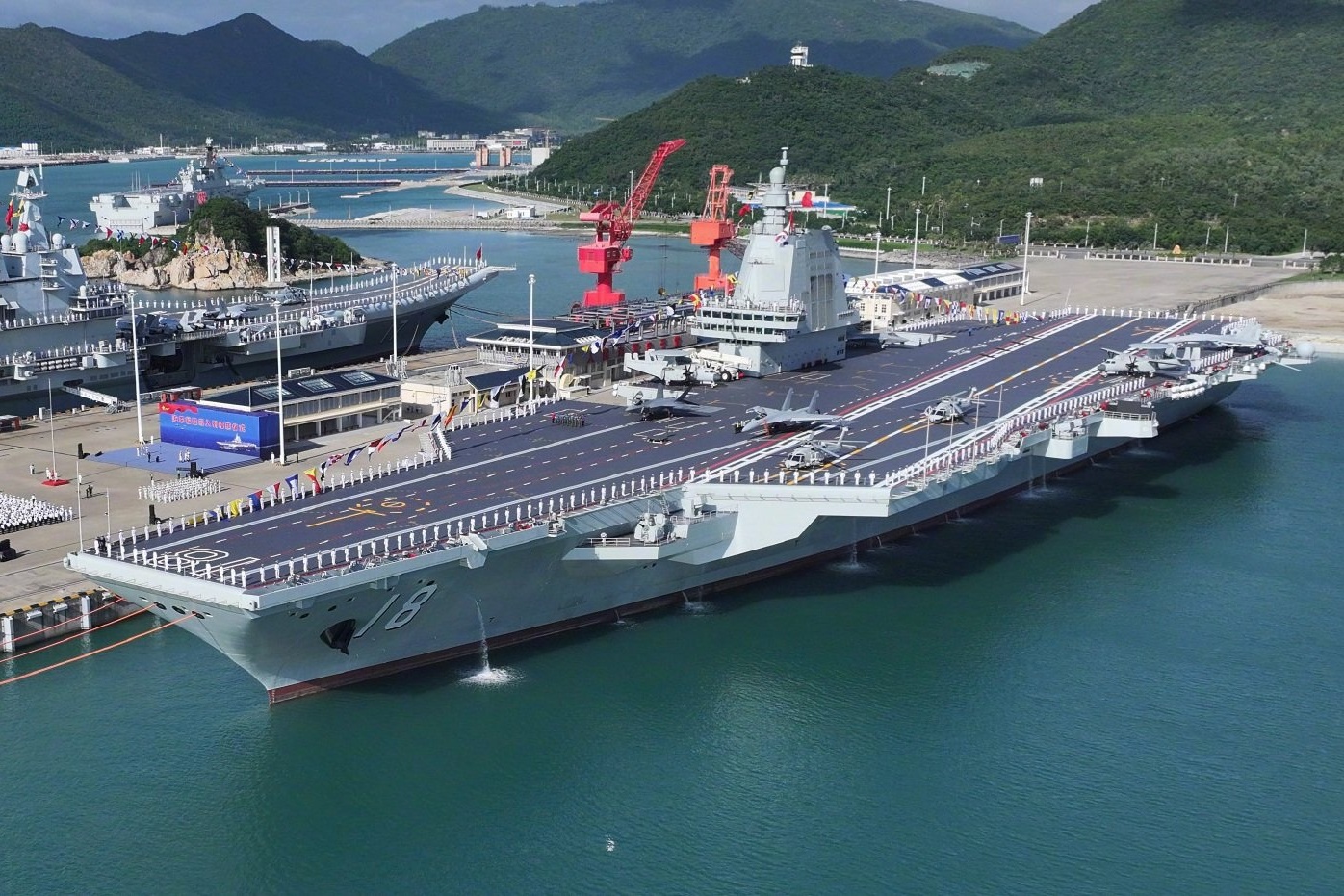
China has officially commissioned its third aircraft carrier, the CNS Fujian, marking a pivotal milestone in the nation’s naval modernization and military capabilities. The commissioning ceremony, held on November 5, 2025, in Sanya, Hainan, was attended by Chinese President Xi Jinping, who inspected the vessel and participated in the formal acceptance into service, according to state news agency Xinhua.
The Fujian stands out as China’s first indigenously built aircraft carrier equipped with electromagnetic catapult systems, known as EMALS. This technology allows the ship to launch heavier and more diverse aircraft compared to traditional ski-jump carriers. Its flat deck and advanced launch systems place China among a select group of nations, including the United States, that operate carriers with similar electromagnetic launch capabilities.
The aircraft carrier's air wing is reported to include the stealth fighter Shenyang J-35, the J-15T, an upgraded variant of the J-15, and the KJ-600 airborne early-warning aircraft. Recent test footage from September 2025 demonstrates these aircraft conducting catapult launches and arrested landings, indicating its operational maturity. Estimated displacements suggest the Fujian exceeds 80,000 tons, making it the largest carrier in China’s fleet and comparable in size to some U.S. supercarriers, capable of supporting roughly 40 to 60 aircraft.
Powered conventionally, the Fujian’s operational endurance is expected to be shorter than the nuclear-powered U.S. carriers. While its deployment area has not been publicly announced, experts believe it will enhance China’s ability to project power across the Western Pacific, including strategic regions like the South China Sea and near Taiwan. The U.S. Navy currently operates 11 nuclear supercarriers, capable of carrying approximately 70 aircraft and crewed by about 5,000 personnel each, maintaining a technological and operational edge.
This development signifies China's growing technical self-sufficiency and strategic naval expansion, emphasizing its ambitions for greater regional influence and naval power projection in the coming years.

