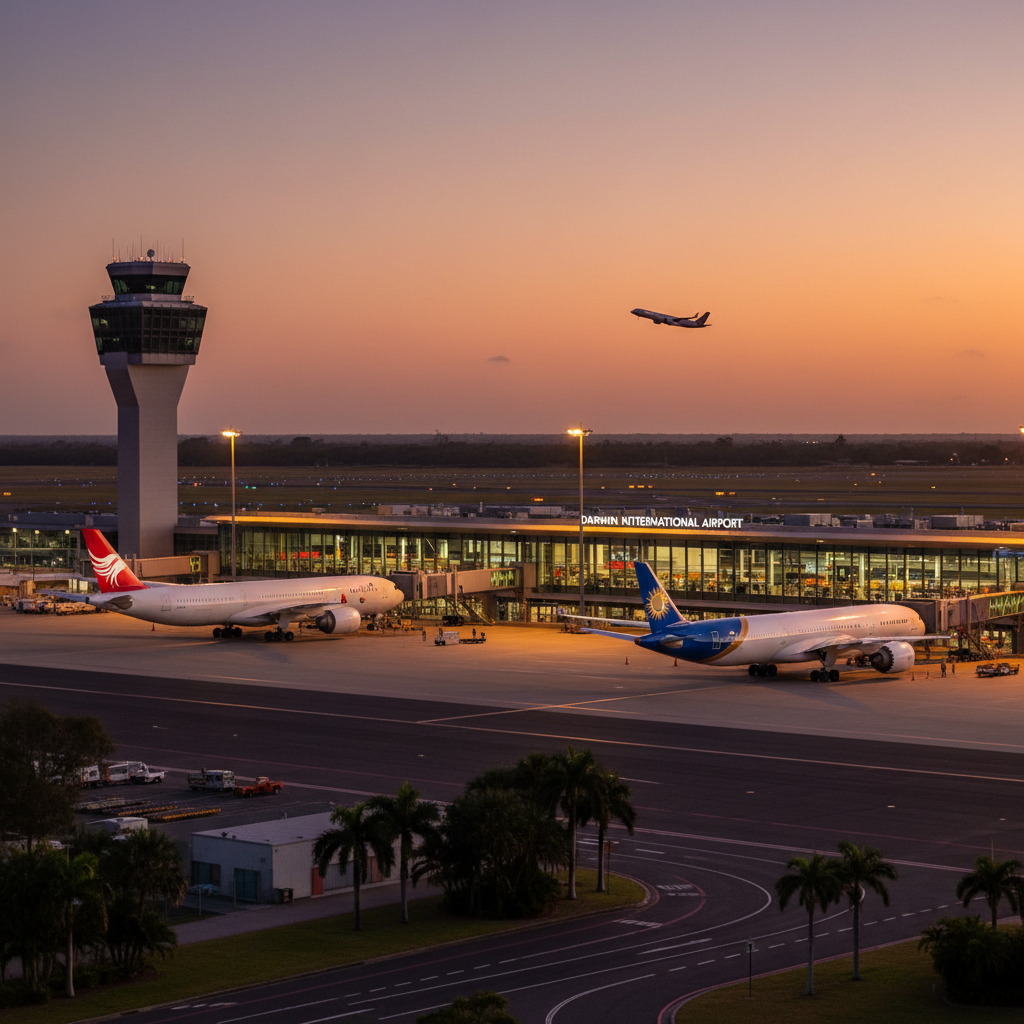
Darwin International Airport (DRW) is aiming to grow its international connections, leveraging its strategic northern location in Australia and proximity to major Asian markets. Currently serving nearly 2 million passengers annually, DRW functions as a vital gateway for domestic and international travel, with its geographic positioning providing closer links to Southeast Asian cities than some Australian cities.
Data from OAG Schedules Analyser indicates that Singapore is DRW’s top international destination by scheduled capacity during the northern summer 2026, with approximately 48,500 seats. Other key international markets include Dili with about 32,500 seats, Bali with over 30,000, and Guangzhou with 4,700 seats. The recent expansion of Dili’s route follows Aero Dili’s launch of its first-ever service to Australia earlier this year.
Domestic and International Capacity
Domestically, flights to Brisbane are the most capacity-rich during summer 2026, with around 129,500 seats, followed by Melbourne and Sydney. Airnorth has announced increased frequencies to Tennant Creek to enhance local connectivity.
Looking ahead, Darwin Airport seeks to establish additional nonstop routes within the Asia-Pacific region. Currently unserved destinations include Kuala Lumpur, Tan Son Nhat, Ninoy Aquino, Lombok, and others. The airport’s strategy focuses on expanding its international network to better connect northern Australia with key Asian hubs, fostering economic growth and tourism.
Overall, Darwin Airport is positioning itself as a significant gateway to Asia-Pacific, aiming to increase international services and strengthen its role as an international aviation hub in the region.

