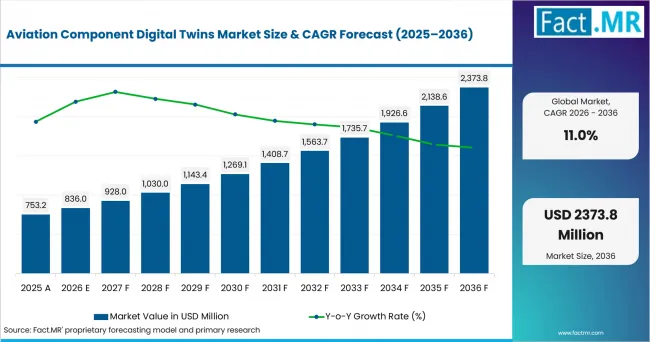
The aviation industry is witnessing a rapid expansion in the use of digital twin technology for aircraft components, with the market expected to reach USD 2,373.8 million by 2036. Currently valued at USD 836.0 million in 2026, this growth is driven by innovations in lifecycle monitoring and condition-based maintenance strategies. Key regions include the USA, Germany, France, and Japan, which benefit from high aircraft activity and mature aerospace sectors.
Market demand is primarily led by engine components and outputs that estimate remaining lifespan, providing critical data for maintenance, repair, and overhaul (MRO) planning. Industry leaders such as Siemens, Dassault Systèmes, and GE Aerospace are at the forefront, offering integrated platforms that support manufacturing, in-service monitoring, and lifecycle management of aircraft parts. These digital innovations aim to enhance safety, reduce costs, and improve aircraft availability across the industry.
Market Drivers and Key Segments
Factors such as lifecycle data continuity, the need for early fault detection, and regional aviation activity impacts are significant growth drivers. Conversely, challenges include validation requirements and system integration with legacy setups. The market’s segmentation includes component types like engines, landing gear, and avionics, with physics-based, data-driven, and hybrid twin models dominating adoption patterns.
This sector’s evolution depends heavily on technological convergence, with support from major aerospace and software companies. As adoption accelerates, digital twins are expected to become central tools for predictive maintenance, lifecycle extension, and operational efficiency in aerospace manufacturing and MRO activities.
Overall, the predicted CAGR of 11.0% reflects the industry’s commitment to embracing digital solutions for safer, more efficient aircraft operations and maintenance strategies worldwide.

