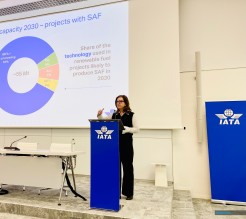
The International Air Transport Association (IATA) Chief Economist Marie Owens Thomsen has highlighted the critical role of the energy transition in Asia-Pacific as a vital economic growth strategy. She emphasized that investments in renewable energy, feedstock production, and sustainable aviation fuel (SAF) are essential for the region to capitalize on one of its few promising growth opportunities. Thomsen remarked that aviation contributes significantly to GDP growth and has a catalytic impact that reinforces the importance of adopting comprehensive energy policies.
Thomsen pointed out that global progress in SAF development depends heavily on policy coordination and clear regulatory frameworks. She noted that some countries, notably China, Indonesia, and Malaysia, are emerging as key biomass feedstock hotspots, with the potential to produce substantial SAF volumes by 2050. Malaysia has actively launched initiatives such as the New Industrial Master Plan and the Malaysia Aviation Decarbonisation Blueprint to achieve net-zero emissions by 2050.
The Need for Broader Energy Planning
She stressed that SAF production must be integrated into national energy strategies, beginning with renewable power development like solar and wind energy. Countries should avoid narrow focuses on digital or industrial projects and prioritize foundational energy investments to enable industry decarbonization, including aviation.
According to IATA estimates, an annual investment of approximately US$174 billion will be necessary between 2024 and 2050 to meet industry decarbonization goals through SAF adoption.
Economic Importance of Air Cargo
Thomsen also underscored the vital role of air cargo in enabling global trade resilience, especially during disruptions such as tariffs. She highlighted its contribution beyond passenger movement, preventing significant economic downturns and supporting international trade flows.
Overall, the focus on energy transition as an economic growth driver positions SAF and renewable energy as essential to future sustainable development for the aviation sector and the wider economy.

