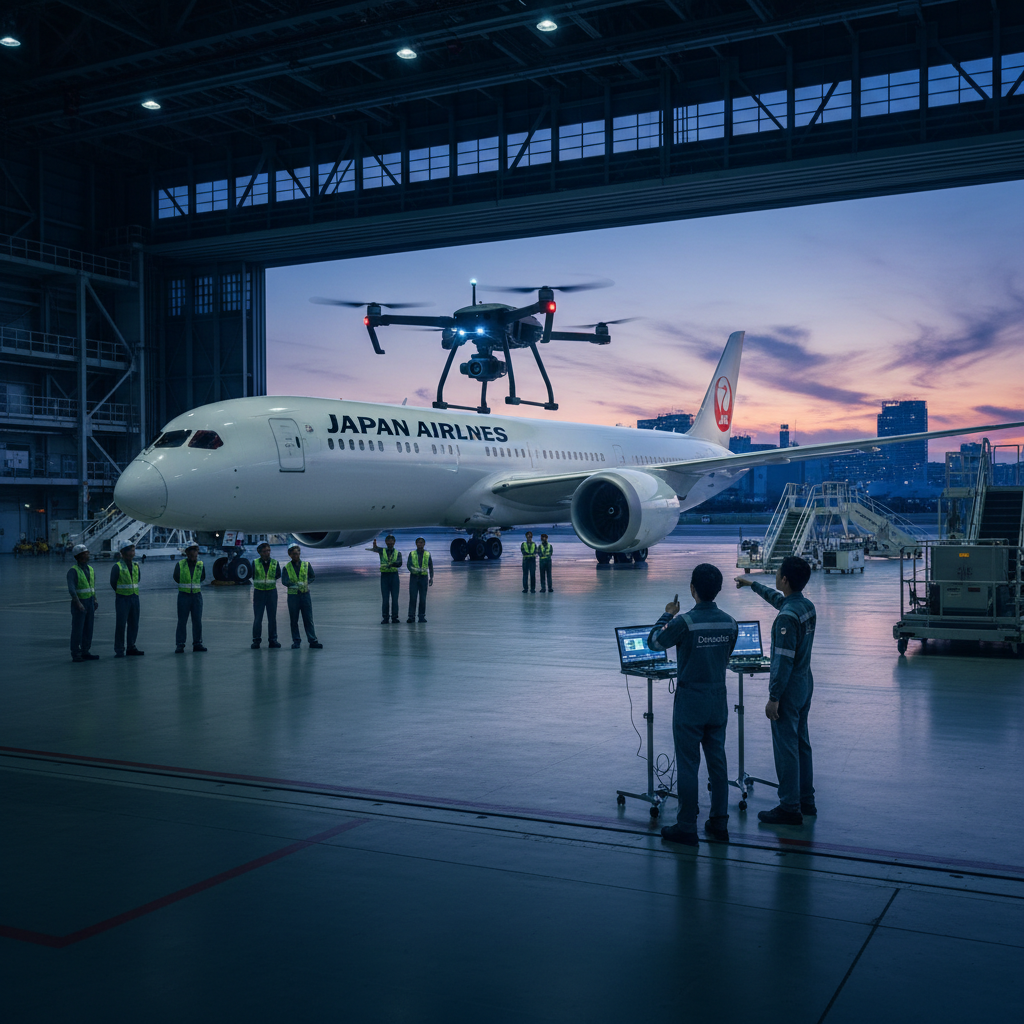
Japan Airlines has initiated the country’s first joint project utilizing drones for fully automated aircraft exterior inspections in a demonstration at its hangars. The airline is working with Toulouse-based drone company Donecle, employing its Iris GVI drones to capture high-resolution images that technicians review for maintenance purposes. This technology aims to increase inspection safety and efficiency by replacing manual visual checks performed at heights. Since late June, JAL has been comparing drone imagery against traditional methods to assess technology effectiveness.
The project’s current scope involves operational testing, with future plans potentially expanding to inspections related to lightning strikes and regular aircraft paint condition monitoring. In September, Donecle announced new developments including a drone inspection tool in partnership with AkzoNobel for assessing aircraft coating performance, measuring thickness, color, and gloss.
Donecle recently secured €10 million in capital funding to support its global expansion and advances in AI technology. Also in April, JetBlue selected Donecle’s drones for inspecting Airbus A220 and A320 aircraft families. Several Asia-Pacific airlines, including HAECO Group, Korean Air, and ST Engineering, have tested or adopted similar drone inspection technologies.
Lindsay Bjerregaard, the managing editor for Aviation Week’s MRO coverage, explains that drone inspection integration is transforming aircraft maintenance, making it safer and faster. As drone technology progresses, airlines are exploring broader applications for automated inspections beyond traditional visual checks, aligning with the industry’s push toward digitalization and efficiency.

