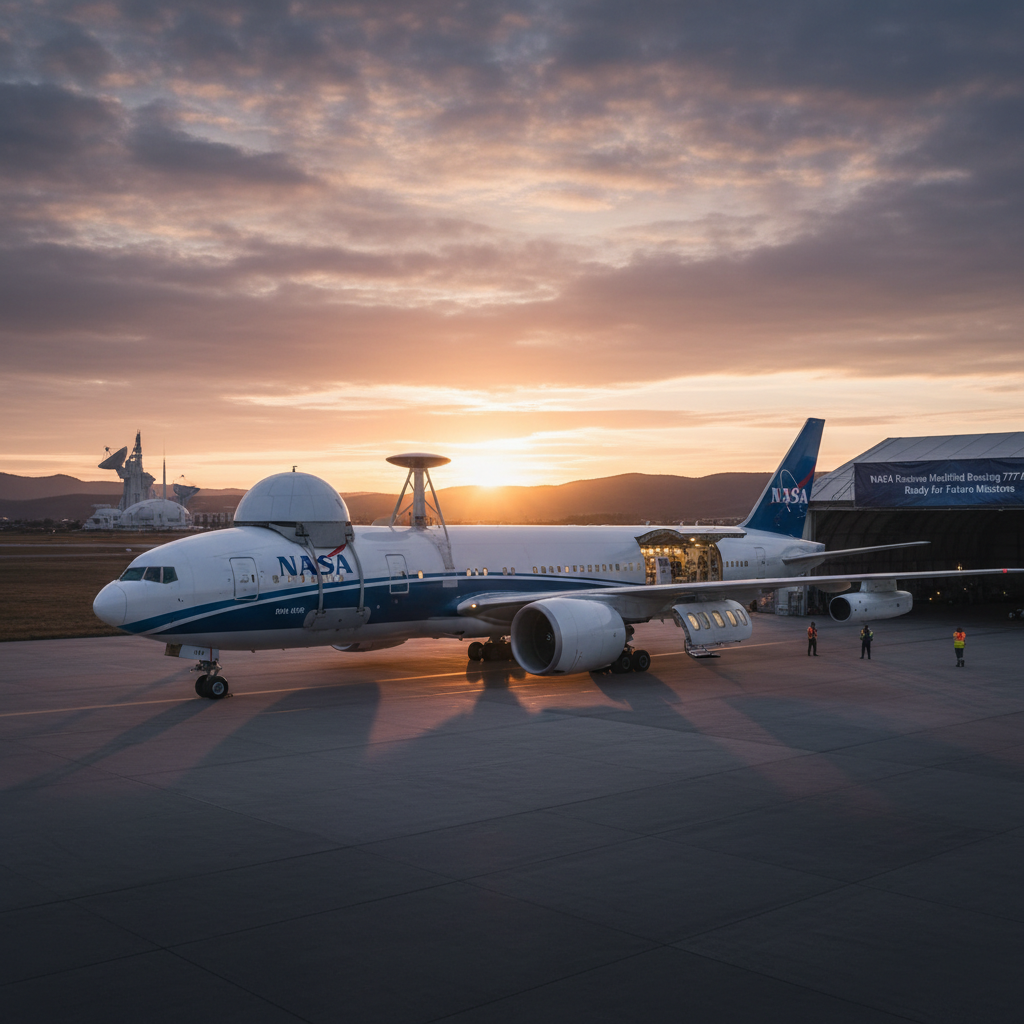
NASA has taken delivery of its modified Boeing 777-200ER airborne science laboratory, marking a significant step toward operational deployment for research purposes. The aircraft, which was converted by L3Harris Technologies in Waco, Texas, is expected to begin initial research activities by January 2027. Originally operated by Japan Airlines and acquired by NASA in 2022, the aircraft has undergone extensive modifications to serve as an airborne science platform.
The Boeing 777 research aircraft will facilitate various scientific missions, extending NASA's capabilities for atmospheric and environmental studies. The modifications include specialized instrumentation and laboratory installations to support air-borne science experiments. The aircraft’s return to NASA's Langley Research Center signifies progress in NASA’s efforts to enhance research infrastructure.
The aircraft as a research platform
The aircraft is part of NASA’s broader strategy to leverage existing large aircraft for advanced scientific research. By reorienting commercially available aircraft for scientific use, NASA aims to achieve high-impact research at reduced costs, enabling faster deployment and flexible operations. The agency plans to conduct a series of test flights and research missions, with the first targeted for early 2027. This aircraft will serve as a key asset in NASA’s ongoing efforts to understand atmospheric processes and support future exploration missions.
Guy Norris, a senior editor at Aviation Week, commented on the aircraft's status, noting the importance of such modifications in expanding the agency’s research tools. The modified Boeing 777 exemplifies NASA’s innovative approach in utilizing commercially available aircraft for scientific advancement and space exploration support.

