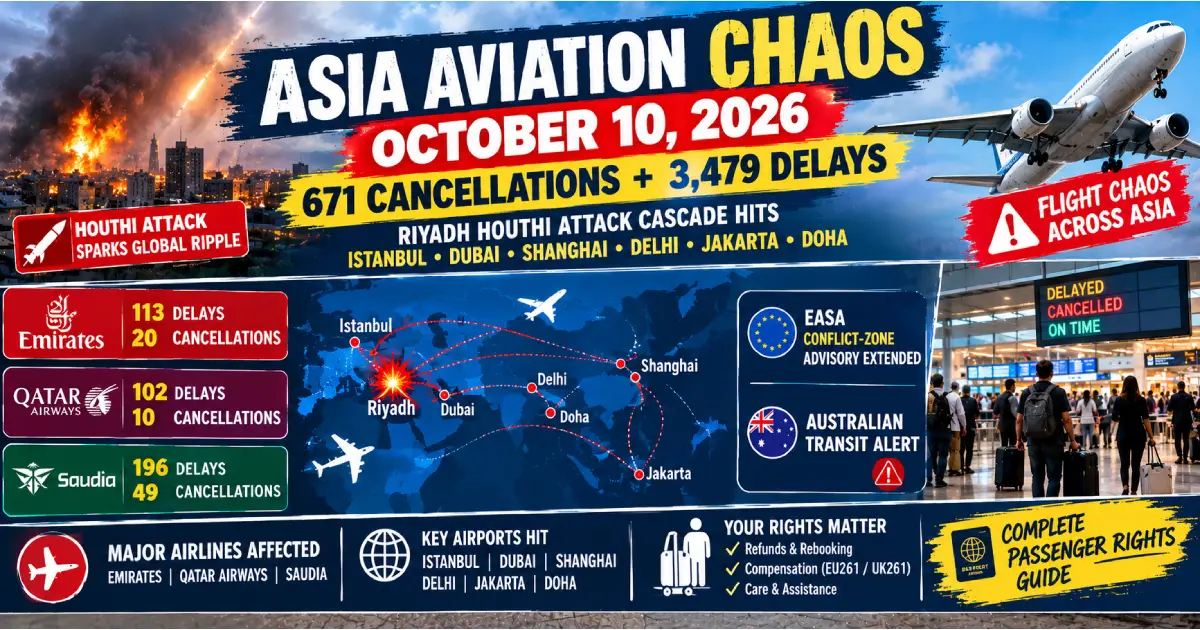
On October 8, 2026, a missile attack by Houthis on Riyadh’s King Khalid International Airport sparked a widespread operational crisis across the Asian and Middle Eastern aviation sectors. The attack resulted in three deaths, damage to a Saudia Airbus A320, and the closure of the airport, which disrupted numerous flights and airline schedules throughout the region.
FlightAware data from October 9 disclosed 671 cancellations and 3,479 delays on a network stretching from Istanbul to Jakarta, and Guangzhou to Delhi. The region's major hubs—Dubai International, Doha Hamad International, and Istanbul Airport—saw significant delays and operational strain, impacting international passengers and regional economies.
Impacts on Airlines and Airports
Airlines such as Saudia, Emirates, Qatar Airways, and Turkish Airlines faced intense disruptions, with Turkish Airlines alone accounting for nearly 300 delays and 25 cancellations. Dubai’s Emirates carrier was delayed 113 times with 20 cancellations, while Qatar Airways reported 102 delays and 10 cancellations. Jakarta Soekarno-Hatta experienced the highest delays among Southeast Asian airports, illustrating the far-reaching effects of the regional airspace disturbances.
"This security event at Riyadh has created a chain reaction affecting hundreds of flights across continents," said an aviation analyst.
The European Union Aviation Safety Agency (EASA) extended its Gulf conflict advisory, requiring airlines to perform additional safety assessments and re-route flights, adding to operational complexities. The incident reveals how a security incident at a single airport can cascade into worldwide aviation delays, challenging airlines and travelers to adapt rapidly.
Travelers are urged to check their flight statuses in advance, especially those passing through Dubai, Doha, or Istanbul, and to prepare for potential rebooking. Aviation authorities and airlines continue to monitor the situation, emphasizing safety and operational resilience amid ongoing tensions.

