Houthi Attacks Disrupt Over Quarter of Saudi Flights
Houthi Attacks Disrupt Over Quarter of Saudi Flights
Trending
|
2 days ago
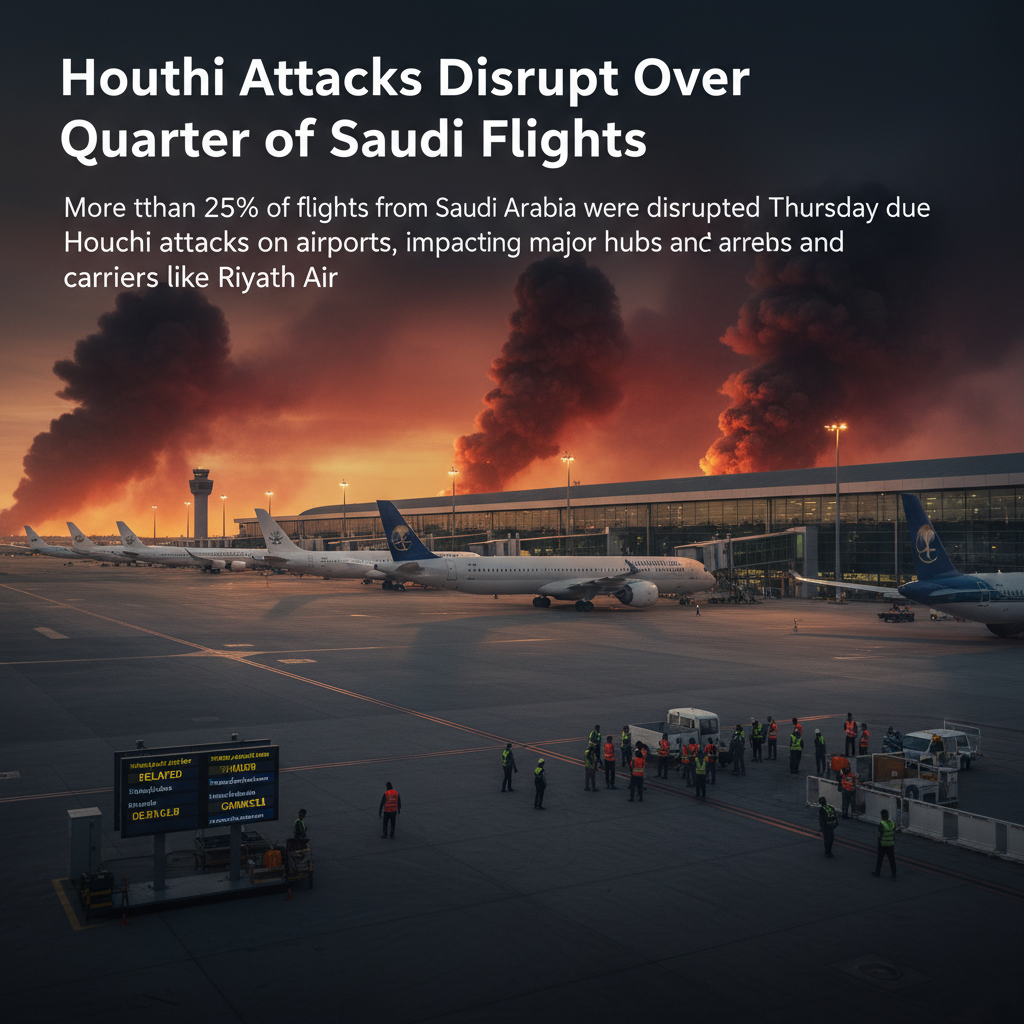
October 9, 2026 — More than a quarter of all flights departing Saudi Arabia were disrupted on Thursday, October 8, following increased attacks on the kingdom's airports by Iran-aligned Houthi rebels. Aviation analytics firm Cirium reported that 312 of 1,194 scheduled departures were either canceled or did not operate.
The disruptions occurred after Houthi forces targeted Abha International Airport and Riyadh's King Khalid International Airport. Saudi Arabia's General Authority of Civil Aviation confirmed that previous attacks on Tuesday and Wednesday resulted in three fatalities and 36 injuries. A Houthi spokesperson, Yahya Sareea, claimed responsibility for a ballistic missile strike on Riyadh's King Khalid Airport via social media on Thursday, stating it caused "damage and disrupting air traffic."
Riyadh Airport Heavily Impacted
Riyadh's King Khalid International Airport experienced significant operational challenges. As of 6 p.m. local time on Thursday, nearly half of all scheduled departures from the airport were either canceled or had not flown. Cirium data indicated that 188 of 378 departures from King Khalid International were affected.
National flag carrier Saudia bore the brunt of the disruptions, with 169 of its 402 departures, or 42%, canceled or non-operational. Other Saudi airlines, Flynas and Flyadeal, also saw substantial impacts, with 27% and 26% of their departures disrupted, respectively. Riyadh Air, a new entrant, opted to pause all departures from Riyadh for the remainder of Thursday.
Wider Regional Implications
The recent attacks exacerbate existing concerns regarding aviation security in Saudi airspace. The European Union Aviation Safety Agency (EASA) had already issued an advisory on September 30, urging operators to avoid Saudi airspace due to missile and drone risks. This advisory is now influencing airline routing and scheduling decisions beyond the immediate impact zones.
For instance, Wizz Air has postponed the restart of its Abu Dhabi and Dubai flights from October 25 to March 27, 2027. The airline cited longer flight times and commercially unviable economics for its A321neo and A321XLR operations as reasons for the delay, stemming from the need to re-route around the advised airspace.
Ongoing Security Concerns
The recurrent targeting of Saudi airports by Houthi rebels underscores a growing threat to aviation reliability in the Gulf region. While some international carriers like Etihad, Royal Jordanian, Air Arabia, and Pegasus maintained full schedules during Thursday's events, the broader trend raises questions about the long-term operational environment for airlines utilizing the Gulf's major aviation hubs. The reliability, a key selling point for these hubs, faces increasing scrutiny amidst the escalating security situation.

Share to:
Latest news
Related airlines
powered by We Do Dev Work 
We use cookies and similar technologies to enhance your Browse experience, personalize content and ads, provide social media features, and analyze our traffic. By clicking 'Accept All' or continuing to use our website, you consent to the use of cookies as described in our Cookie Policy